Page 1
- Home
- Thoughts on Art, Creativity & Inspiration
- Friends
- Good Stories
- Tutorials
- Free Pieced Houses
- Lynne Tyler Word Quilts ~2009 - 2010
- Lynne Tyler Word Quilts ~ 2011
- Lynne Tyler Quilts ~ 2012
- Lynne Tyler Quilts ~ 2013
- Lynne Tyler Quilts ~ 2014
- Lynne Tyler 2015-2016 Quilts
- Lynne Tyler Quilts - 2017
- Lynne Tyler Quilts 2018
- 2019 Quilts
- 2020 Quilts
- 2021 Finished Quilts
- 2022 Quilts
- 2023 Quilts
- My Studio
- 2024 Quilts
- 2025 Quilts
- Doll Swap Quilts
- Details, Details & More Organization Stuff
- Couch, Bed & Table Quilts
- Scrap Slab Triangle Quilts
- Gizzy Quilts
- Slashed Squares Quilts
- Zebras
- Diamond Quilts
- Table Quilts
- Flight Of Fancy Hints
- Not Yet Finished...
- Quilts & Their Owners
Wednesday, October 31, 2018
Binding Tute & Class
You'd think binding a quilt would be easy, but nope! There are a myriad of things that can go wrong.
I'm writing a tutorial about binding a quilt. It will include everything I know about how to do it so it lies flat, is even and the stitching is invisible. I've talked about how I do it on this blog so many times that I can summarize it in 81 words. The tutorial is 41 pages long and counting, so clearly there is more to it that that!. I'll show you how every single thing I do sets me up for success. I know lots of little tips that can make the task easier.
How do I know this?
At this writing I have bound over 310 quilts. That means I have made 310 invisible joins and mitered 1,240 corners. I'm kind of an expert.
The binding tute isn't ready yet. It needs another two weeks of writing and then it will run the gauntlet of my four editors, Julie, Allison, Megan and Mary. They will beat me up and I will fight back, object, and eventually give in. Or not. But each one of them brings a terrific skill to the process and have helped me make my tutorials clear and concise. That process typically takes a month. So look for the finished tutorial round about the middle of December. Don't worry. You'll hear about it here first.
And here's the exciting news. I'll be teaching a Binding class at Quilted Threads sometime in 2019.
I thought you'd like a little taste, so here's a binding hint. When you are mitering a corner, (as in the photo above,) use a small, flat, thin object, like the tip of a seam ripper to hold down one side of the binding while you fold the other side over to make a mitered corner. It helps reduce the bulkiness that can happen there.
Monday, October 29, 2018
I Am A Bowl Freak, Part 2
I love bowls, especially the big decorative ones that are designed for your dining room table. I have a few of them, and you can read about them here. Now that I have finished the October table quilt, I need a bowl for it, so I went to Home Goods this morning.
I found these two leaf shaped glass bowls for eight bucks each. The green fabric scraps are fabrics I used in the Early Autumn quilt. Yup. That was easy.
Here are the bowls on the Fall House Top quilt I use for November. They're more like small platters.
I think they are going to be better on the Early Autumn quilt, but speaking of leaves...
This was the view outside my living room window on Sunday afternoon.
I created a Blog Page that shows all my table quilts. You can find it here. There is also a link on the header.
I found these two leaf shaped glass bowls for eight bucks each. The green fabric scraps are fabrics I used in the Early Autumn quilt. Yup. That was easy.
Here are the bowls on the Fall House Top quilt I use for November. They're more like small platters.
I think they are going to be better on the Early Autumn quilt, but speaking of leaves...
This was the view outside my living room window on Sunday afternoon.
I created a Blog Page that shows all my table quilts. You can find it here. There is also a link on the header.
Saturday, October 27, 2018
The Creative Process Crossroads
My pal Julie sent this to me the other day and I thought it was terrific, so I had to share it with you. I'm (clearly) in the group jumping hurdles and hang gliding off the cliff to the right...
Thursday, October 25, 2018
Questions & Answers, Part Two
Yesterday I shared some of my responses to comments about my Early Autumn quilt. Here are more.
Jean wrote, "Since you like to be closed in by evergreens, you should enjoy western WA or western OR. Over the Cascade Mountains on the east side we seem to be able to see forever!"
Actually Jean, I have family in Hood River Oregon, in the Columbia River Gorge. It's one of my favorite parts of the country. Driving east along SR14 on my way to visit the Maryhill Museum, I got a glimpse of those vast expanses you mentioned. And being able to see Mt Hood from... everywhere? Priceless.
Robby wrote, "[You] got me thinking about light in the forest. If you make one of those background trees in that block lighter or partially so, will it look like the sun streaming into the forest?"
Well Robby, the answer is a big "maybe." Look at the picture above. Look at it QUICKLY, then look away. What part of it did your eye go to first? It went to the lightest white tree in the middle right part of the picture. You can argue you didn't notice it first, but you are MISTAKEN! It is the way the BRAIN works. You have no control over it. Your eye (anybody's eye) will be drawn to the area of highest contrast first. Artists know that, and they use that to manipulate what your eye goes to first when it looks at something.
There's one tiny problem though. A very bright area surrounded by much darker stuff can occasionally look like a hole. That is bad. So the artist has to be very careful with the placement of "the lightest light" in a piece of art. In my quilt, I wasn't interested in how the light looks as it is filtered through trees in a forest or the woods. I simply wanted green and color. I was not interested in creating a three-dimensional space either. I just wanted to play with the repeating tall triangle shape of the trees and the colors of fall to suggest "Early Autumn."
Notice I said "suggest." I didn't want to hit you over the head with it. I wanted to capture the feeling of the woods in early autumn. I didn't need the "gimmicks," the pumpkins, corn stalks, or cabins in the woods. That would have weakened the graphic quality of the quilt and made it "cute." For the record, I hate, loathe and despise "cute" (except where small children and my granddaughter are concerned). I do not make "cute" quilts. Cute is for six year olds and I am not six.
Three days into my work on this quilt, Rita commented, "I love tree quilts very much. When I look at this one it is, I'm afraid to say, depressing. It is the colors; the trees are mostly dark..."
Rita was right. It WAS mostly dark, but three days into this I had not yet found my feet, and did not know where this was going. My immediate reaction to this comment was, "Rita, gimme a break, I haven't got started yet." Sometimes there is a point in the creation of a piece of art that it just looks like crap and doesn't seem to have any potential whatsoever. That's not a bad place for me, because it's at that place where I do my best creative thinking. My breakthrough came three days later.
Alice wrote, "I do hope you will do a tutorial on this one. Will put it in my "definitely want to try."
Dear Alice, making free pieced trees is pretty easy and I'm betting you could find a how-to on the internet without too much trouble. After making this quilt and hearing how everybody likes my overlapping trees... I think I will write a short tree-making tutorial that will include how to make overlapping trees. However, do not expect full blown instructions on how to make the entire quilt.
Yesterday Sue asked, "If you use it as a tablecloth do you use batting? And is it flat enough to put glasses and such on it?"
Yes, Sue, The quilts I use as table covers all have batting and are quilted and finished like normal quilts. I have one of those plastic flannel backed tablecloths underneath the quilt, to protect my mahogany table from spills. Sometimes I use coasters underneath glasses and I have been known to use placemats on top of the quilt if I am really worried about something spilling or staining.
On the very first day I blogged about making a tree quilt, my pal Julie wrote. "I am VERY sure that your tree quilt is going to be a knockout!"
My first thought was how nice it was that my best friend had such faith in me. Then I thought, oh hell, how am I going to that?
I love reading all your comments. They tell me whether what ends up in the quilt is what I had in my head when I conceived it. Just because I think it's there doesn't mean it really is. I need to see it through your eyes. Thanks.
Jean wrote, "Since you like to be closed in by evergreens, you should enjoy western WA or western OR. Over the Cascade Mountains on the east side we seem to be able to see forever!"
![]() |
| This is Mt Hood in Oregon. |
Actually Jean, I have family in Hood River Oregon, in the Columbia River Gorge. It's one of my favorite parts of the country. Driving east along SR14 on my way to visit the Maryhill Museum, I got a glimpse of those vast expanses you mentioned. And being able to see Mt Hood from... everywhere? Priceless.
~ ~ ~ ~ ~
Robby wrote, "[You] got me thinking about light in the forest. If you make one of those background trees in that block lighter or partially so, will it look like the sun streaming into the forest?"
Well Robby, the answer is a big "maybe." Look at the picture above. Look at it QUICKLY, then look away. What part of it did your eye go to first? It went to the lightest white tree in the middle right part of the picture. You can argue you didn't notice it first, but you are MISTAKEN! It is the way the BRAIN works. You have no control over it. Your eye (anybody's eye) will be drawn to the area of highest contrast first. Artists know that, and they use that to manipulate what your eye goes to first when it looks at something.
There's one tiny problem though. A very bright area surrounded by much darker stuff can occasionally look like a hole. That is bad. So the artist has to be very careful with the placement of "the lightest light" in a piece of art. In my quilt, I wasn't interested in how the light looks as it is filtered through trees in a forest or the woods. I simply wanted green and color. I was not interested in creating a three-dimensional space either. I just wanted to play with the repeating tall triangle shape of the trees and the colors of fall to suggest "Early Autumn."
Notice I said "suggest." I didn't want to hit you over the head with it. I wanted to capture the feeling of the woods in early autumn. I didn't need the "gimmicks," the pumpkins, corn stalks, or cabins in the woods. That would have weakened the graphic quality of the quilt and made it "cute." For the record, I hate, loathe and despise "cute" (except where small children and my granddaughter are concerned). I do not make "cute" quilts. Cute is for six year olds and I am not six.
~ ~ ~ ~ ~
Three days into my work on this quilt, Rita commented, "I love tree quilts very much. When I look at this one it is, I'm afraid to say, depressing. It is the colors; the trees are mostly dark..."
Rita was right. It WAS mostly dark, but three days into this I had not yet found my feet, and did not know where this was going. My immediate reaction to this comment was, "Rita, gimme a break, I haven't got started yet." Sometimes there is a point in the creation of a piece of art that it just looks like crap and doesn't seem to have any potential whatsoever. That's not a bad place for me, because it's at that place where I do my best creative thinking. My breakthrough came three days later.
~ ~ ~ ~ ~
Alice wrote, "I do hope you will do a tutorial on this one. Will put it in my "definitely want to try."
Dear Alice, making free pieced trees is pretty easy and I'm betting you could find a how-to on the internet without too much trouble. After making this quilt and hearing how everybody likes my overlapping trees... I think I will write a short tree-making tutorial that will include how to make overlapping trees. However, do not expect full blown instructions on how to make the entire quilt.
~ ~ ~ ~ ~
Yesterday Sue asked, "If you use it as a tablecloth do you use batting? And is it flat enough to put glasses and such on it?"
Yes, Sue, The quilts I use as table covers all have batting and are quilted and finished like normal quilts. I have one of those plastic flannel backed tablecloths underneath the quilt, to protect my mahogany table from spills. Sometimes I use coasters underneath glasses and I have been known to use placemats on top of the quilt if I am really worried about something spilling or staining.
~ ~ ~ ~ ~
On the very first day I blogged about making a tree quilt, my pal Julie wrote. "I am VERY sure that your tree quilt is going to be a knockout!"
My first thought was how nice it was that my best friend had such faith in me. Then I thought, oh hell, how am I going to that?
~ ~ ~ ~ ~
I love reading all your comments. They tell me whether what ends up in the quilt is what I had in my head when I conceived it. Just because I think it's there doesn't mean it really is. I need to see it through your eyes. Thanks.
Labels:
Answers,
creativity,
persistence,
process,
questions,
thoughts
Wednesday, October 24, 2018
Lynne Answers Your Questions
I love reading your comments, both the ones at the bottom of my posts and those of you who email me privately. I welcome all your comments, and I thought you'd like to hear my reaction to some of the ones I have received while I made the Early Autumn quilt.
On Sunday, Starr wrote: "I certainly did not mean to criticize your design or cause you any angst. I was just trying to understand more about your use of color, which is so wonderful!"
Dear Starr, don't apologize for your comment or your observation. You were absolutely correct. I had thought removing the white tree would fix the problem, but it didn't. The angst was all mine. I tell everybody all the time that we know when it's right, and we know when it's wrong, but when we're not sure, it helps to have another opinion. I had been on the fence about it, and your comment made me take a second look. Thank you.
Judy asked, "Can you make a block with 3 trees overlapping? Or trim both sides of 2 trees and stick a smaller one between them to give the depth of looking into the forest???"
Hi Judy, CAN I? Sure I can make 3 overlapping trees, however in order to show one is in front of another, or that two are in front of a third, you have to use your fabrics and colors correctly. Remember this general rule: "Dark areas recede, bright areas come forward"
Melanie made my day with this comment: "This is an out of the box layout for me. I'm very much an "ordered" layout person. I appreciate seeing things presented in different ways and this is going to be very nice. Also, thanks for using the word "comprise" correctly."
Dear Melanie, It's an out-of-the-box layout for me too, but I've come to learn that creativity isn't always neat, logical or ordered. Also, I've never received a compliment for my grammar, so thanks! I'm sure it's due to a lifelong love of reading.
TEM Austin wrote: "This is very interesting... I love it that you show how your mind works and why you do what you do when. I do a lot of improv but I never seem to think it thru like you do."
Dear TEM Austin, I never think of myself as an improv quilter. I never start without an idea and just see where my whimsy takes me. I always have an idea, and I follow where it leads, changing direction as necessary and as needed. I've said it before, "what the quilt wants, the quilt gets." Quilts, like any other kind of artwork, make demands of the artist as the work progresses and each decision depends on the ones that came before it, and limit and inform the ones that come after. Thinking these decisions through is vital. Nothing in my quilts, not the fabric, the shapes, the design or the colors, is willy-nilly. I think about, and plan, everything. Every. Single. Thing.
SewGirl writes: "I was going to suggest you just make a bunch of table runners!! But you obviously know what you're doing... "
Dear SewGirl, Thanks for the vote of confidence, but until I found my way in this quilt, I didn't know what the hell I was doing at all! I was just blundering around. The difference is that after creating for over forty years, "blundering around" doesn't frighten or intimidate me in the least. After forty years of making art I have learned to trust my instincts and my process. I have always "figured it out" in the past, and I know I will again.
Along the same lines, Linda wrote: "I like the grouping of trees together, mixing the sizes and adding in more of the reds. What a difference from where you started. Not sure I have the same patience..."
Linda, as a quilter, I am sure you have heard people say, "How long did this quilt take to make?" and "How many pieces does it have in it?" Then they'll say, "Oh, you have so much patience." I don't care how long it took. I don't care how many pieces it has, and I don't think you need patience if you're doing something you love. I love solving creative problems, so for me "patience" is not a requirement." (Actually it's more of a "I am going to figure this damn thing out if it's the last thing I do kinda thing.")
OK, That's it for tonight. I'll have more for you tomorrow!
~ ~ ~ ~ ~
On Sunday, Starr wrote: "I certainly did not mean to criticize your design or cause you any angst. I was just trying to understand more about your use of color, which is so wonderful!"
Dear Starr, don't apologize for your comment or your observation. You were absolutely correct. I had thought removing the white tree would fix the problem, but it didn't. The angst was all mine. I tell everybody all the time that we know when it's right, and we know when it's wrong, but when we're not sure, it helps to have another opinion. I had been on the fence about it, and your comment made me take a second look. Thank you.
~ ~ ~ ~ ~
Judy asked, "Can you make a block with 3 trees overlapping? Or trim both sides of 2 trees and stick a smaller one between them to give the depth of looking into the forest???"
Hi Judy, CAN I? Sure I can make 3 overlapping trees, however in order to show one is in front of another, or that two are in front of a third, you have to use your fabrics and colors correctly. Remember this general rule: "Dark areas recede, bright areas come forward"
~ ~ ~ ~ ~
Melanie made my day with this comment: "This is an out of the box layout for me. I'm very much an "ordered" layout person. I appreciate seeing things presented in different ways and this is going to be very nice. Also, thanks for using the word "comprise" correctly."
Dear Melanie, It's an out-of-the-box layout for me too, but I've come to learn that creativity isn't always neat, logical or ordered. Also, I've never received a compliment for my grammar, so thanks! I'm sure it's due to a lifelong love of reading.
~ ~ ~ ~ ~
TEM Austin wrote: "This is very interesting... I love it that you show how your mind works and why you do what you do when. I do a lot of improv but I never seem to think it thru like you do."
Dear TEM Austin, I never think of myself as an improv quilter. I never start without an idea and just see where my whimsy takes me. I always have an idea, and I follow where it leads, changing direction as necessary and as needed. I've said it before, "what the quilt wants, the quilt gets." Quilts, like any other kind of artwork, make demands of the artist as the work progresses and each decision depends on the ones that came before it, and limit and inform the ones that come after. Thinking these decisions through is vital. Nothing in my quilts, not the fabric, the shapes, the design or the colors, is willy-nilly. I think about, and plan, everything. Every. Single. Thing.
~ ~ ~ ~ ~
SewGirl writes: "I was going to suggest you just make a bunch of table runners!! But you obviously know what you're doing... "
Dear SewGirl, Thanks for the vote of confidence, but until I found my way in this quilt, I didn't know what the hell I was doing at all! I was just blundering around. The difference is that after creating for over forty years, "blundering around" doesn't frighten or intimidate me in the least. After forty years of making art I have learned to trust my instincts and my process. I have always "figured it out" in the past, and I know I will again.
Along the same lines, Linda wrote: "I like the grouping of trees together, mixing the sizes and adding in more of the reds. What a difference from where you started. Not sure I have the same patience..."
Linda, as a quilter, I am sure you have heard people say, "How long did this quilt take to make?" and "How many pieces does it have in it?" Then they'll say, "Oh, you have so much patience." I don't care how long it took. I don't care how many pieces it has, and I don't think you need patience if you're doing something you love. I love solving creative problems, so for me "patience" is not a requirement." (Actually it's more of a "I am going to figure this damn thing out if it's the last thing I do kinda thing.")
~ ~ ~ ~ ~
OK, That's it for tonight. I'll have more for you tomorrow!
Labels:
comment,
creativity,
persistence,
problems,
thoughts
Tuesday, October 23, 2018
Early Autumn Flimsy is Complete
The tree quilt, Early Autumn, is now a flimsy. Here are some details:
It measures about 63" x 93".
There are 81 trees.
There are 20 different tree trunk fabrics.
There are 10 different "focus" tree fabrics.
There are 61 different greens.
It measures about 63" x 93".
There are 81 trees.
There are 20 different tree trunk fabrics.
There are 10 different "focus" tree fabrics.
There are 61 different greens.
Monday, October 22, 2018
Early Autumn Showing Off
Since the tree quilt, Early Autumn, was designed for my dining room table, I had to take pictures of it on the table. Here they are.
.
.
I'm really happy I designed it the way I did, and it looks great
.
.
I'm really happy I designed it the way I did, and it looks great
Sunday, October 21, 2018
The Wrong Road
About 10 days ago, I posted this on the blog,
and pointed out the strong diagonal from the light background block on the left, to the white tree on the right. I said it was going to go.
I removed the white tree on the right. I felt it was enough. Before there was a continuous light streak. I felt removing the light tree broke it up. Starsthatblaze disagreed. It didn't bother me THAT much.
Except the more I thought about it, the more it annoyed me. So I removed that light yellow green and replaced it.
The new tree still had to be light, but I think it's better. I could have removed both trees with that light green batik-y background, but I liked the lightness they brought to the overall design.
This is all but one row. I sewed all these panels together into one big chunk, THEN removed the bright yellow tree and replaced it with the less bright fabric.
Because, you know, Starsthatblaze reminded me of a quote I have tacked up on my inspiration wall.
and pointed out the strong diagonal from the light background block on the left, to the white tree on the right. I said it was going to go.
I removed the white tree on the right. I felt it was enough. Before there was a continuous light streak. I felt removing the light tree broke it up. Starsthatblaze disagreed. It didn't bother me THAT much.
Except the more I thought about it, the more it annoyed me. So I removed that light yellow green and replaced it.
The new tree still had to be light, but I think it's better. I could have removed both trees with that light green batik-y background, but I liked the lightness they brought to the overall design.
This is all but one row. I sewed all these panels together into one big chunk, THEN removed the bright yellow tree and replaced it with the less bright fabric.
Because, you know, Starsthatblaze reminded me of a quote I have tacked up on my inspiration wall.
Saturday, October 20, 2018
Close-Up
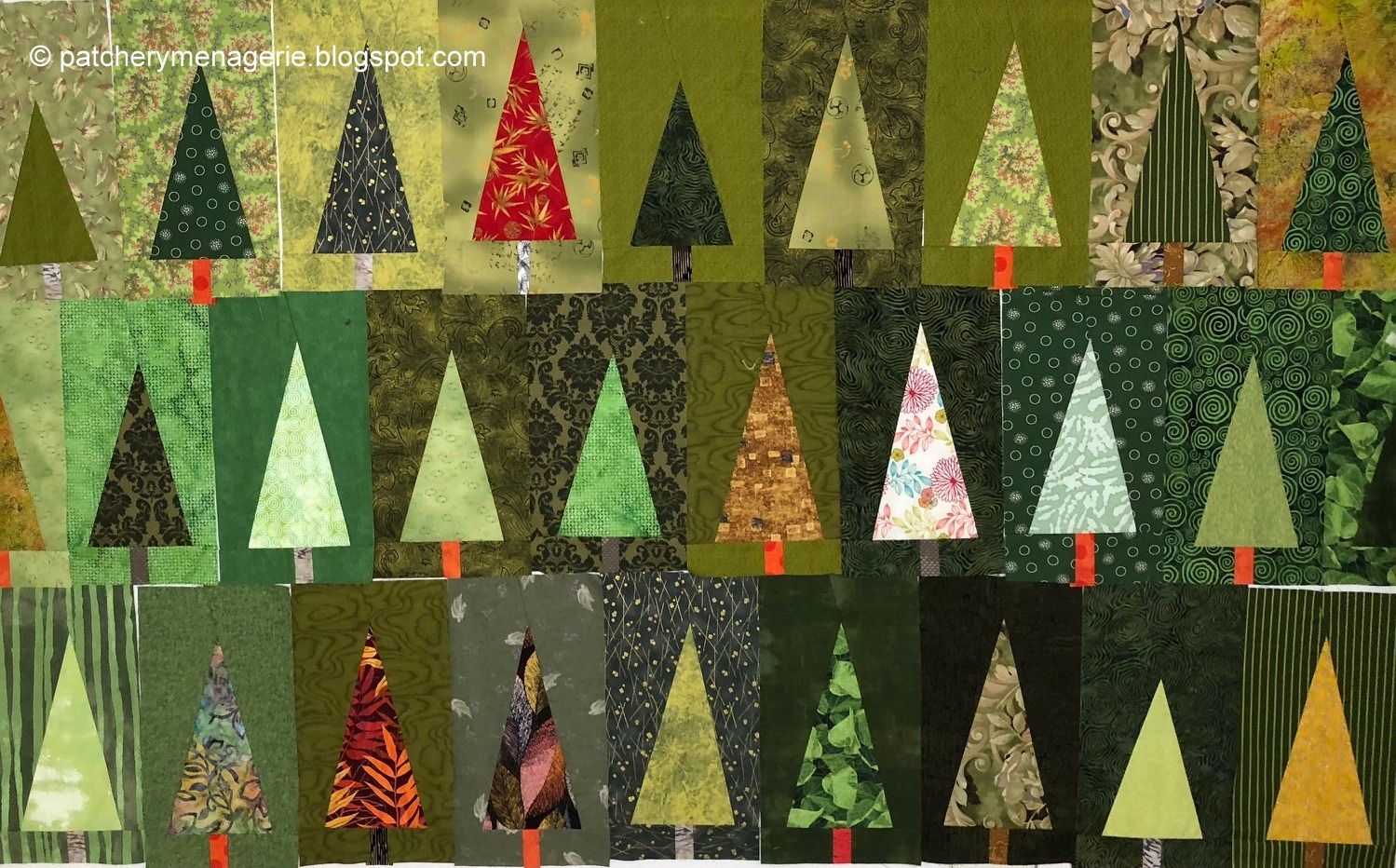
I've sewn the bottom row together into one long panel. I thought you might like to see close ups of the trees so you could enjoy the different fabrics and how I used them.
Let's see, a batik, an oriental, a wild modern print and a couple of blenders...
The green print at the bottom is from 2009, then there are lots of blenders. See the trunk of the yellow tree? Hold that thought.
Another batik and a lot of blenders. That big leaf fabric? That's the same fabric I used for the tree trunk of the yellow tree in the photo above. Moving right along, an Oriental and more blenders (and see that batik that's the trunk of the red tree? That's the background of the Black Box quilt.) Moving over again, some fabrics sent to me by Rondi, blenders all.
I love the olive-y fabric with the waving rows of varying sized white dots. Another gift. Then a batik tree made from leftover fabric that I used in the quilt I made for Julie Sefton, No Rules for Julie in 2009.
And more blenders, a light green Grunge and some Christmas green.
Here's how this bottom row fits with the row above it. I think it's great.
When I started this quilt I had absolutely no idea it would be anything out of the ordinary.
Let's see, a batik, an oriental, a wild modern print and a couple of blenders...
The green print at the bottom is from 2009, then there are lots of blenders. See the trunk of the yellow tree? Hold that thought.
Another batik and a lot of blenders. That big leaf fabric? That's the same fabric I used for the tree trunk of the yellow tree in the photo above. Moving right along, an Oriental and more blenders (and see that batik that's the trunk of the red tree? That's the background of the Black Box quilt.) Moving over again, some fabrics sent to me by Rondi, blenders all.
I love the olive-y fabric with the waving rows of varying sized white dots. Another gift. Then a batik tree made from leftover fabric that I used in the quilt I made for Julie Sefton, No Rules for Julie in 2009.
And more blenders, a light green Grunge and some Christmas green.
Here's how this bottom row fits with the row above it. I think it's great.
When I started this quilt I had absolutely no idea it would be anything out of the ordinary.
Friday, October 19, 2018
The Final Push
I'd been burning the midnight oil working on this quilt, and I finally needed to rest so the last couple of evenings I have been reading and getting to bed a lot earlier.
I haven't done any sewing since last time, but I have been doing some rearranging. I needed some more brightness in the top section (the first rows I sewed together now seem too much the same), so I will replace some of those green trees with colored ones. Yes, I will remove the block and replace it. Yes, right in the middle of a quilt. You should all know I'll rip anything out if I don't feel it is working.***
I'm not a big fan of too much light/dark contrast at the edges or corners of a quilt, so the upper right and lower left corners have changed from light backgrounds with dark trees to something more middle ground. I know it looks dark in the pictures, but it really isn't quite that dark in real life.
I've also shifted the bottom row over to the right a bit. I didn't want two blocks of overlapping trees to be directly one on top of the other. And since I have taken this photo, I made another change. In this photo there are overlapping trees in each of the four corners. Not anymore! I don't want this quilt to be too predictable, I want it to be balanced, but look random.
That, my friends, is a balancing act indeed!
***In my quilt The Black Box, I made every element at least twice. I made all the letters twice, I made the rays twice, and I made the box itself three times.
I haven't done any sewing since last time, but I have been doing some rearranging. I needed some more brightness in the top section (the first rows I sewed together now seem too much the same), so I will replace some of those green trees with colored ones. Yes, I will remove the block and replace it. Yes, right in the middle of a quilt. You should all know I'll rip anything out if I don't feel it is working.***
I'm not a big fan of too much light/dark contrast at the edges or corners of a quilt, so the upper right and lower left corners have changed from light backgrounds with dark trees to something more middle ground. I know it looks dark in the pictures, but it really isn't quite that dark in real life.
I've also shifted the bottom row over to the right a bit. I didn't want two blocks of overlapping trees to be directly one on top of the other. And since I have taken this photo, I made another change. In this photo there are overlapping trees in each of the four corners. Not anymore! I don't want this quilt to be too predictable, I want it to be balanced, but look random.
That, my friends, is a balancing act indeed!
***In my quilt The Black Box, I made every element at least twice. I made all the letters twice, I made the rays twice, and I made the box itself three times.
Wednesday, October 17, 2018
Close But No Cigar
I've got the right side column done, all the way to the bottom row (which isn't finished yet). Those pieces in the corners are just placeholders. I'm not at all convinced that left side row is ready to be sewn together... the four trees below the dark green tree with the busy leafy background look a bit monotonous... OH LOOK... the top half of each of those rows contain overlapping trees, but neither bottom half does. That has to change. Maybe that will fix what bugs me.
And you know me. I can't leave well enough alone. Here I have shifted the bottom row to the floor so I can put the topmost row where it belongs so finally I can see the whole thing the way it might be. I see a few things I may tinker with.
That should surprise nobody.
And you know me. I can't leave well enough alone. Here I have shifted the bottom row to the floor so I can put the topmost row where it belongs so finally I can see the whole thing the way it might be. I see a few things I may tinker with.
That should surprise nobody.
Tuesday, October 16, 2018
The Light at the End of the Tunnel...
Since I really wanted to see everything all together, I got the bright idea of hanging that last row from the edge of the shelf above my design wall, and then pinning the other edge to the top of the design wall. Obviously it isn't centered, and it looks funny, but it gives me enough information to make some final design decisions.
1. I thought it would be the red trees that would lead the viewer into this quilt, but I was wrong. It is the yellow trees (not surprising, they are the brightest element in the quilt. Note I didn't say lightest, I said brightest. There is a difference. They eye is drawn to contrast.) I will have to add some yellow to that top row. No biggie, that's what seam rippers are for.
2. The idea of having tiny trees diminish in size at the corners of the quilt is just not going to work. They would look to "tricky" and "cutesy" and since trees like that aren't really shown in the quilt anywhere else, they'd look out of place. So I decided to just carry on with the trees in the top and bottom-most rows, like shown in the picture above. The blocks in the corners here aren't blocks at all, just fabric scraps thrown up on the design wall. But you get the idea.
If you think this whole thing was easy, let me enlighten you. Colors change depending on what colors are next to them. A green that looked dark suddenly looked light when I'd put it next to some tree blocks. Olive colored fabrics looked really green sometimes, and sickly yellow others.
Fabrics that looked like they had a medium texture or print suddenly looked downright "blender"-like when placed next to something busier. And don't even THINK of putting a busy background print with a busy tree print. Sometimes a print would just disappear next to the "right" (translation: wrong) fabric, and I'd never know until I tried to find a home for it. Some fabrics like to play along only in the most particular circumstances, and sometimes not at all.
Green and Red are very close to each other in "brightness" or "intensity." If you want something to look really red, put it next to something green, but they can't be the same value (lightness or darkness) or both colors will look like mud. Really. So putting the red trees in wasn't by any stretch of the imagination an easy task, particularly since I like to distribute my fabrics, scale of print, and color all around the quilt. Look at the placement of the red trees if you do not believe me.
Sometimes fabrics I was convinced would NOT work proved me a liar by working beautifully. Which was fine except I didn't have much of them, and I'd have to resort to piecing scraps together just to get a tree triangle, or background.
I pulled virtually every single piece of green fabric I owned out of my stash. When my worktable is this cluttered
and my ironing table is piled with fabric, it's hard to work. I actually had to spend two hours cleaning on Sunday before I could work on the quilt. I just didn't have space to press and straighten the big panels once I started sewing them together.
But I'm close. I can see the light at the end of the tunnel.
Monday, October 15, 2018
The Other End
I've sewn the central panel of the tree quilt together, and here it is on my dining room table. I also have named the quilt: Early Autumn.
I've moved all the blocks so the quilt is "upside down" from the way I have been working on it until now. I've removed the bottom-most row and set it aside so I have room to design the corresponding row at the other end of the quilt. I could have moved everything lower on the design wall, but I wanted to see it "right side up" and I didn't want to be working on a step stool all the time.
I have to make a lot more trees, and since I have new fabrics, I have to be careful to make sure the new fabrics don't look new or of out of place.
I've moved all the blocks so the quilt is "upside down" from the way I have been working on it until now. I've removed the bottom-most row and set it aside so I have room to design the corresponding row at the other end of the quilt. I could have moved everything lower on the design wall, but I wanted to see it "right side up" and I didn't want to be working on a step stool all the time.
I have to make a lot more trees, and since I have new fabrics, I have to be careful to make sure the new fabrics don't look new or of out of place.
Sunday, October 14, 2018
Scrap Slabs Class at Quilted Threads
I love small classes. Students get so much personal attention. These are the ladies from yesterday's Scrap Slab Triangles class at Quilted Threads.
The biggest benefit of a class is the ability for the students to see what can happen when they start arranging a large number of the blocks on a design wall. It's all we do for the last hour of the day, and it is usually the most powerful, as the ladies see the tremendous possibilities of this simple block.
The Scrap Slabs class always inspires ME too! I particularly love this layout and already have ideas in my head to make a quilt using this arrangement.
The fall foliage is really looking good, in spite of the rain. I had to pull over and take a photo on the ride to Henniker yesterday.
I shopped for some greens and reds and golds to finish the tree quilt.
The biggest benefit of a class is the ability for the students to see what can happen when they start arranging a large number of the blocks on a design wall. It's all we do for the last hour of the day, and it is usually the most powerful, as the ladies see the tremendous possibilities of this simple block.
The Scrap Slabs class always inspires ME too! I particularly love this layout and already have ideas in my head to make a quilt using this arrangement.
The fall foliage is really looking good, in spite of the rain. I had to pull over and take a photo on the ride to Henniker yesterday.
I shopped for some greens and reds and golds to finish the tree quilt.
Friday, October 12, 2018
Can You See Me Now?
This is the central part of the tree quilt. Look a bit familiar, but not quite? It's because this is upside down from the way you usually have been looking at it.
If you have been having a hard time with this quilt, with the trees going in four directions, it helps if you look at it strictly as an abstract design of color and shape.
This is the same quilt, "right side up" and without the bottom row chopped off. I've been "fine tuning" and made a couple more yellow trees and another overlapping tree. You can find them.
The blocks on the vertical rows on either side have not been sewn together, but everything else has been. When I sew those long side chunks together, and then sewn those to the central panel, I'll flip the quilt upside down as in the first photo and design the extra row across the top (because my design wall isn't big enough).
I know I've said it before, but I am really, really, really, liking this quilt.
Thursday, October 11, 2018
A Star is Born
Not my quilt, the movie, which I went to see last night. Enjoyed it very much.
My quilt is getting to the point where I am happy enough with it to start sewing big chunks of it together. I will be able to sew the five big sections that comprise the "top" of the table quilt together later, then the section on the far right. The vertical row on the far left still needs work, as does the yet undesigned row that will be above the top row.
I'm teaching the Scrap Slab Triangles class at Quilted Threads on Saturday, so I won't be finishing this for another couple of weeks, but I am very happy with it.
Wednesday, October 10, 2018
Getting Closer...
I worked on the topmost row last night. Oh wait a minute...
This might be a bit easier for you.
And if you are wondering did I fussy cut the tree on the far right and the olive-y tree fabric with the rows of meandering dots...
Heck yeah!
Subscribe to:
Comments (Atom)