Showing posts with label persistence. Show all posts

Thursday, September 1, 2022

The Wallpaper

 I don't understand why some people can't understand why I do what I do. To me, if I want it bad enough, I will do whatever I have to do to make it happen.

So when I mess up, like this above (I didn't measure correctly),
 

I had to fix it.

(Incidentally, I was crawling ON the countertop to reach this corner and install the wallpaper. Kinda cramped.)

Installing the wallpaper inside the hutch was no small feat either. I used a small portable light to help me to see what I was doing.

I had to order another roll of the light wallpaper, as you can see - I need to replace that piece on the middle right and paper the sides.

Just like sewing together the blocks of a quilt really tightens up the design, the wallpaper properly installed looks really great.

I've reached the window over the sink. I removed the molding so I could fit the wallpaper behind it. I'll also paint the trim before it goes back up.
 

I'm pretty excited to get my kitchen back. It's getting closer!

Monday, September 28, 2020

Straight...


I hate having edges of my blocks or panels on the bias, so when I have to add fabric to these blocks, I really try to make sure my edges are on the straight of the grain. So complicated, and fussy though this is, I added this bit of fabric so the bottom edge is on the straight of the grain.

On this block, all four sides are on the straight of the grain.

This is what I have so far. This is not easy. This is Hard.

This is the purplish block in my drawing above. Putting these five together took more than six hours, and I ripped seams apart more than once. It is NOT exactly what is shown in my sketch above, but it's close enough, and still conveys the feeling I wanted to convey, so it's OK.

Annie, in her comment yesterday, wanted to look at "a tutorial on how you do [it.]"

When you have completely internalized how to do a task, you do it without thinking. So to ask me to explain this I really do have to stop and think. Remember I went to Art School and I know how to draw. I can literally draw anything I want and have it look real. Knowing how to draw not only means learning to see, but it means learning how to measure with your eyes. I don't translate what I see in things like inches, but I can translate the shapes I see on my design wall (or in my sketch above) and reproduce them in the fabric in front of me. What I am really reproducing here is the "negative space," or the shape of the spaces between the things (asterisks). 

In the sketch above, what's colored is what I have sewn together. See the tall thin green shape up there?

Using that part of the design, this is what the end result looks like. I had to add something to the bottom of the bottom asterisk, so I did that. Then I had to figure out the position of the top asterisk, and add fabric to the sides of that. Then I had to figure out the angle of the top asterisk, which is slightly tilted. Then I had to figure out how much space there was between the two. Then I sewed them together. Then I had to add space at the top. I trimmed down the extra space (making sure I left a seam allowance all the way around).

That is "all" there is to it. And yes, I am well aware this is well beyond the skill of even the most advanced quilter. But you must remember I have been drawing and measuring with my eyes, for over 50 years. So while this is certainly hard, and tricky, and complicated, and frustrating, for me it is not intimidating.

My friend Julie said once that "You persist with an idea well beyond the time when most of us would have run screaming from the room." I'm persistent too. I have set myself up with this challenge, and I will solve it.

Now IF I have done it right, then each finished panel will look like the appropriate section in my sketch above. There are 22 sections in the quilt. If I sew each of them as accurately as I can, then my finished quilt will so closely resemble my original layout that nobody will know the difference, and the feeling of asterisks floating away on the wind will be achieved.

Thursday, October 25, 2018

Questions & Answers, Part Two

Yesterday I shared some of my responses to comments about my Early Autumn quilt. Here are more.

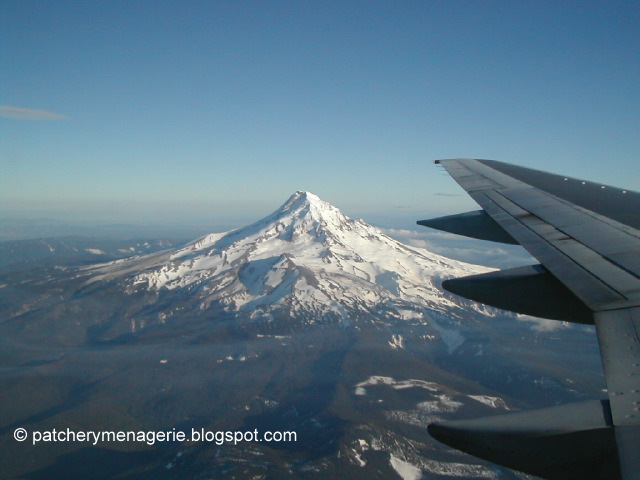
Jean wrote, "Since you like to be closed in by evergreens, you should enjoy western WA or western OR. Over the Cascade Mountains on the east side we seem to be able to see forever!"

This is Mt Hood in Oregon.

Actually Jean, I have family in Hood River Oregon, in the Columbia River Gorge. It's one of my favorite parts of the country. Driving east along SR14 on my way to visit the Maryhill Museum, I got a glimpse of those vast expanses you mentioned. And being able to see Mt Hood from... everywhere? Priceless.

~ ~ ~ ~ ~

Robby wrote, "[You] got me thinking about light in the forest. If you make one of those background trees in that block lighter or partially so, will it look like the sun streaming into the forest?"


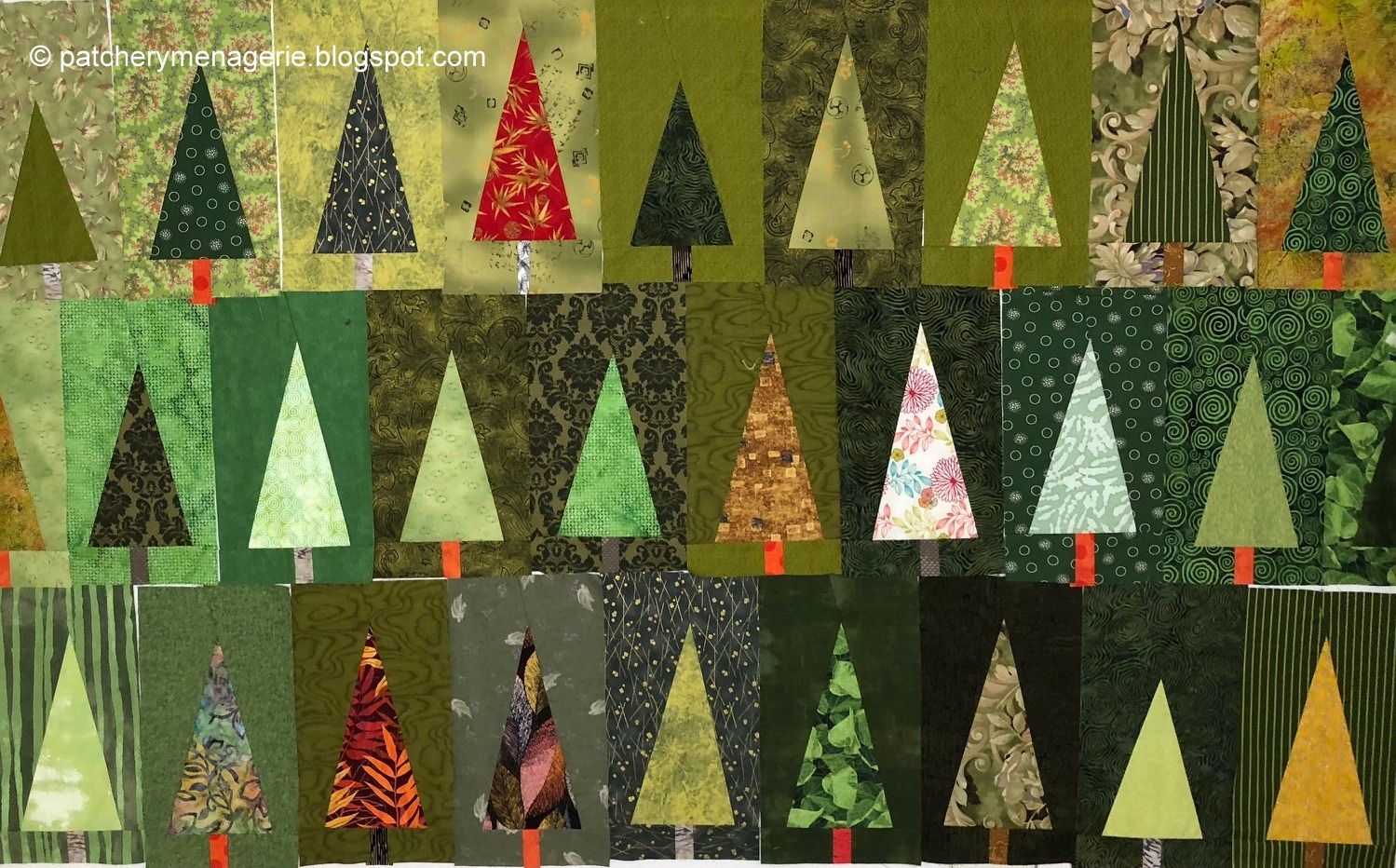
Well Robby, the answer is a big "maybe." Look at the picture above. Look at it QUICKLY, then look away. What part of it did your eye go to first? It went to the lightest white tree in the middle right part of the picture. You can argue you didn't notice it first, but you are MISTAKEN! It is the way the BRAIN works. You have no control over it. Your eye (anybody's eye) will be drawn to the area of highest contrast first. Artists know that, and they use that to manipulate what your eye goes to first when it looks at something.

There's one tiny problem though. A very bright area surrounded by much darker stuff can occasionally look like a hole. That is bad. So the artist has to be very careful with the placement of "the lightest light" in a piece of art. In my quilt, I wasn't interested in how the light looks as it is filtered through trees in a forest or the woods. I simply wanted green and color. I was not interested in creating a three-dimensional space either. I just wanted to play with the repeating tall triangle shape of the trees and the colors of fall to suggest "Early Autumn."

Notice I said "suggest." I didn't want to hit you over the head with it. I wanted to capture the feeling of the woods in early autumn. I didn't need the "gimmicks," the pumpkins, corn stalks, or cabins in the woods. That would have weakened the graphic quality of the quilt and made it "cute." For the record, I hate, loathe and despise "cute" (except where small children and my granddaughter are concerned). I do not make "cute" quilts. Cute is for six year olds and I am not six.

~ ~ ~ ~ ~

Three days into my work on this quilt, Rita commented, "I love tree quilts very much. When I look at this one it is, I'm afraid to say, depressing. It is the colors; the trees are mostly dark..."

Rita was right. It WAS mostly dark, but three days into this I had not yet found my feet, and did not know where this was going. My immediate reaction to this comment was, "Rita, gimme a break, I haven't got started yet." Sometimes there is a point in the creation of a piece of art that it just looks like crap and doesn't seem to have any potential whatsoever. That's not a bad place for me, because it's at that place where I do my best creative thinking. My breakthrough came three days later.

~ ~ ~ ~ ~


 Alice wrote, "I do hope you will do a tutorial on this one. Will put it in my "definitely want to try."

Dear Alice, making free pieced trees is pretty easy and I'm betting you could find a how-to on the internet without too much trouble. After making this quilt and hearing how everybody likes my overlapping trees... I think I will write a short tree-making tutorial that will include how to make overlapping trees. However, do not expect full blown instructions on how to make the entire quilt.

~ ~ ~ ~ ~

 Yesterday Sue asked, "If you use it as a tablecloth do you use batting? And is it flat enough to put glasses and such on it?"


Yes, Sue, The quilts I use as table covers all have batting and are quilted and finished like normal quilts. I have one of those plastic flannel backed tablecloths underneath the quilt, to protect my mahogany table from spills. Sometimes I use coasters underneath glasses and I have been known to use placemats on top of the quilt if I am really worried about something spilling or staining.

~ ~ ~ ~ ~

On the very first day I blogged about making a tree quilt, my pal Julie wrote. "I am VERY sure that your tree quilt is going to be a knockout!"

My first thought was how nice it was that my best friend had such faith in me. Then I thought, oh hell, how am I going to that?

~ ~ ~ ~ ~

I love reading all your comments. They tell me whether what ends up in the quilt is what I had in my head when I conceived it. Just because I think it's there doesn't mean it really is. I need to see it through your eyes. Thanks.


Wednesday, October 24, 2018

Lynne Answers Your Questions

I love reading your comments, both the ones at the bottom of my posts and those of you who email me privately. I welcome all your comments, and I thought you'd like to hear my reaction to some of the ones I have received while I made the Early Autumn quilt.

~ ~ ~ ~ ~

On Sunday, Starr wrote: "I certainly did not mean to criticize your design or cause you any angst. I was just trying to understand more about your use of color, which is so wonderful!"


Dear Starr, don't apologize for your comment or your observation. You were absolutely correct. I had thought removing the white tree would fix the problem, but it didn't. The angst was all mine. I tell everybody all the time that we know when it's right, and we know when it's wrong, but when we're not sure, it helps to have another opinion. I had been on the fence about it, and your comment made me take a second look. Thank you.

~ ~ ~ ~ ~

 Judy asked, "Can you make a block with 3 trees overlapping? Or trim both sides of 2 trees and stick a smaller one between them to give the depth of looking into the forest???"  


Hi Judy, CAN I? Sure I can make 3 overlapping trees, however in order to show one is in front of another, or that two are in front of a third, you have to use your fabrics and colors correctly. Remember this general rule: "Dark areas recede, bright areas come forward"

~ ~ ~ ~ ~

Melanie made my day with this comment: "This is an out of the box layout for me. I'm very much an "ordered" layout person. I appreciate seeing things presented in different ways and this is going to be very nice. Also, thanks for using the word "comprise" correctly."

Dear Melanie, It's an out-of-the-box layout for me too, but I've come to learn that creativity isn't always neat, logical or ordered. Also, I've never received a compliment for my grammar, so thanks! I'm sure it's due to a lifelong love of reading.

~ ~ ~ ~ ~

TEM Austin wrote: "This is very interesting... I love it that you show how your mind works and why you do what you do when. I do a lot of improv but I never seem to think it thru like you do."


 Dear TEM Austin, I never think of myself as an improv quilter. I never start without an idea and just see where my whimsy takes me. I always have an idea, and I follow where it leads, changing direction as necessary and as needed. I've said it before, "what the quilt wants, the quilt gets." Quilts, like any other kind of artwork, make demands of the artist as the work progresses and each decision depends on the ones that came before it, and limit and inform the ones that come after. Thinking these decisions through is vital. Nothing in my quilts, not the fabric, the shapes, the design or the colors, is willy-nilly. I think about, and plan, everything. Every. Single. Thing.

~ ~ ~ ~ ~

SewGirl writes: "I was going to suggest you just make a bunch of table runners!! But you obviously know what you're doing... "

Dear SewGirl, Thanks for the vote of confidence, but until I found my way in this quilt, I didn't know what the hell I was doing at all! I was just blundering around. The difference is that after creating for over forty years, "blundering around" doesn't frighten or intimidate me in the least. After forty years of making art I have learned to trust my instincts and my process. I have always "figured it out" in the past, and I know I will again.

Along the same lines, Linda wrote: "I like the grouping of trees together, mixing the sizes and adding in more of the reds. What a difference from where you started. Not sure I have the same patience..."

Linda, as a quilter, I am sure you have heard people say, "How long did this quilt take to make?" and "How many pieces does it have in it?" Then they'll say, "Oh, you have so much patience." I don't care how long it took. I don't care how many pieces it has, and I don't think you need patience if you're doing something you love. I love solving creative problems, so for me "patience" is not a requirement." (Actually it's more of a "I am going to figure this damn thing out if it's the last thing I do kinda thing.")

~ ~ ~ ~ ~

OK, That's it for tonight. I'll have more for you tomorrow!