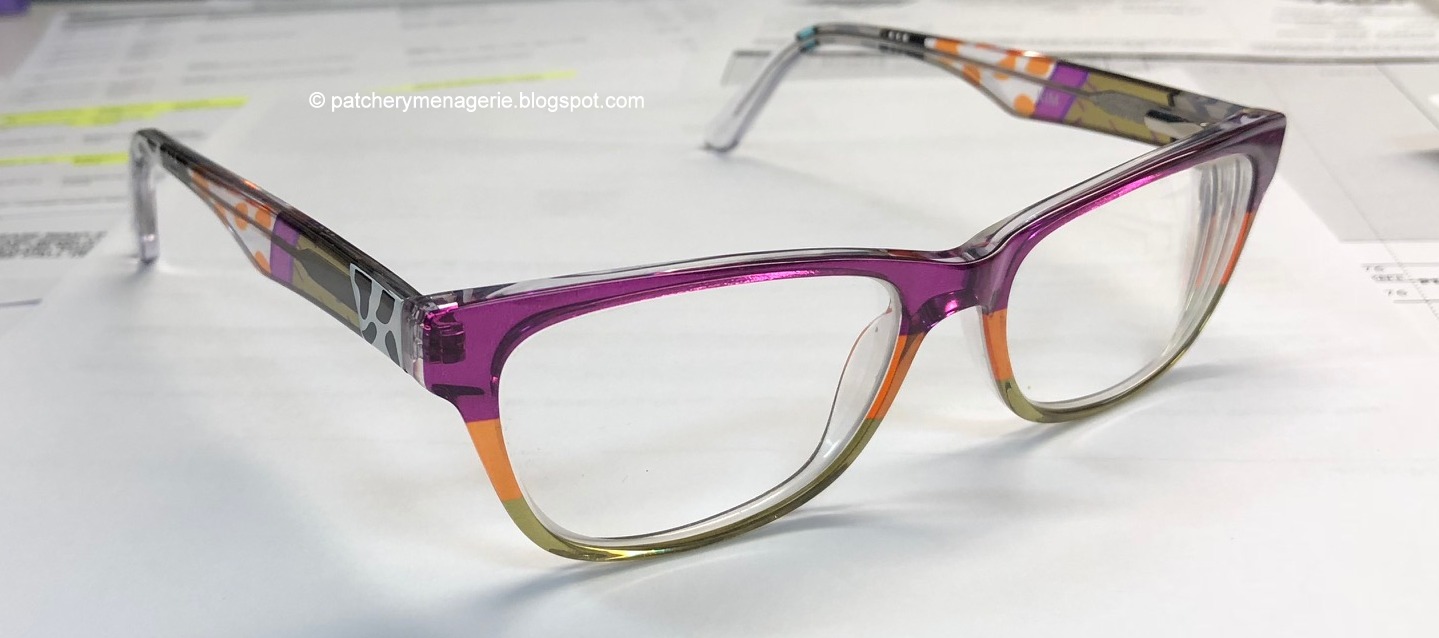
The other day after I showed off my new glasses, my friend Mary told me I should write a post about how a quilter knows when she needs new glasses. It's a fair point.
Before I developed arthritis in my dominant hand, I used to do finely detailed pencil drawings, specifically portraits. To do that, I needed to SEE and to SEE I needed good glasses, so I had plenty of motivation to ask my optometrist if I could get a custom pair of bifocals so I could see what I was drawing without tilting my head up and down. Ordinary bifocals didn't allow me to do that.
"Of course" he said, "Just measure how far away something is you want to see and we'll go from there."
Now anybody with bifocals knows how expensive they are, but let's face it, if you need to SEE to work, then why would you avoid the expense? It's like any other tool you need to do your job. The best tools are worth the cost.
My new glasses (above) are "average" bifocals. Good for driving and not so close work. They're fine when I am working on my laptop when it is on the table, but not so good when the laptop is in my lap. For that I use my "quilting glasses," below.
 |
| these are my "quilting" glasses. |
|
My quilting glasses are designed for middle distance, and close distance. They are good to see anything out to the ends of my arms. They are great for sewing and for teaching. I can't see long distance with them, so I can't drive with them, and they are actually better for reading than my "normal" bifocals. They are great for hand sewing. And yes, when I got them I figured out just how far I sat from my sewing machine, just how far away my cutting and ironing tables were when I worked, and brought those measurements to my optometrist, and we talked about what I needed. (Essentially that was where the "line" dividing one distance from the other would be on the lenses.) I guess they're more like the bottom two areas of trifocals. Thing is, they are worth every penny I paid for them.
So if you are struggling to SEE with your glasses, it's worth your while to find something that works. A lot of people ask why I don't buy the inexpensive "cheaters" you find at grocery stores. Fact is, they don't work for me. I need more than one prescription, I need two. And besides, I think "cheaters" are (for the most part) ugly as sin.
I'm always amazed at what folks will put up with. Most of us ladies are familiar with how uncomfortable an ill-fitting bra can be, but how many of us just buy them off the shelf instead of going someplace to get properly fitted? (Not me, I found a great bra place and I am a believer.) I'm always surprised that women put up with making quilts on dining room tables in rooms with poor lighting, and cheap sewing machines, and wobbly ironing boards designed for ironing clothes, not quilts, yet their husbands have table saws, snowblowers and riding lawnmowers.
And about lighting...
A couple of years ago I bought a small Ott Lite to use when I hand sew the binding on my quilts. Glasses are one thing, but good lighting is another thing that will make your life a LOT easier. One of the things I adore about
Quilted Threads, my all time favorite quilt shop, is that the lighting is bright daylight, not ordinary fluorescent. When I moved into the house I live in now, the first thing I did was bring myself to the hardware store to buy daylight bulbs to replace every single bulb and lamp. What a difference. (Although I do have to install spots in my studio for my design wall. I hope that's a project I can do before the end of this year.)
So, all my quilting pals... Can you see?